Screenshots
Screenshots
Click to enlarge.
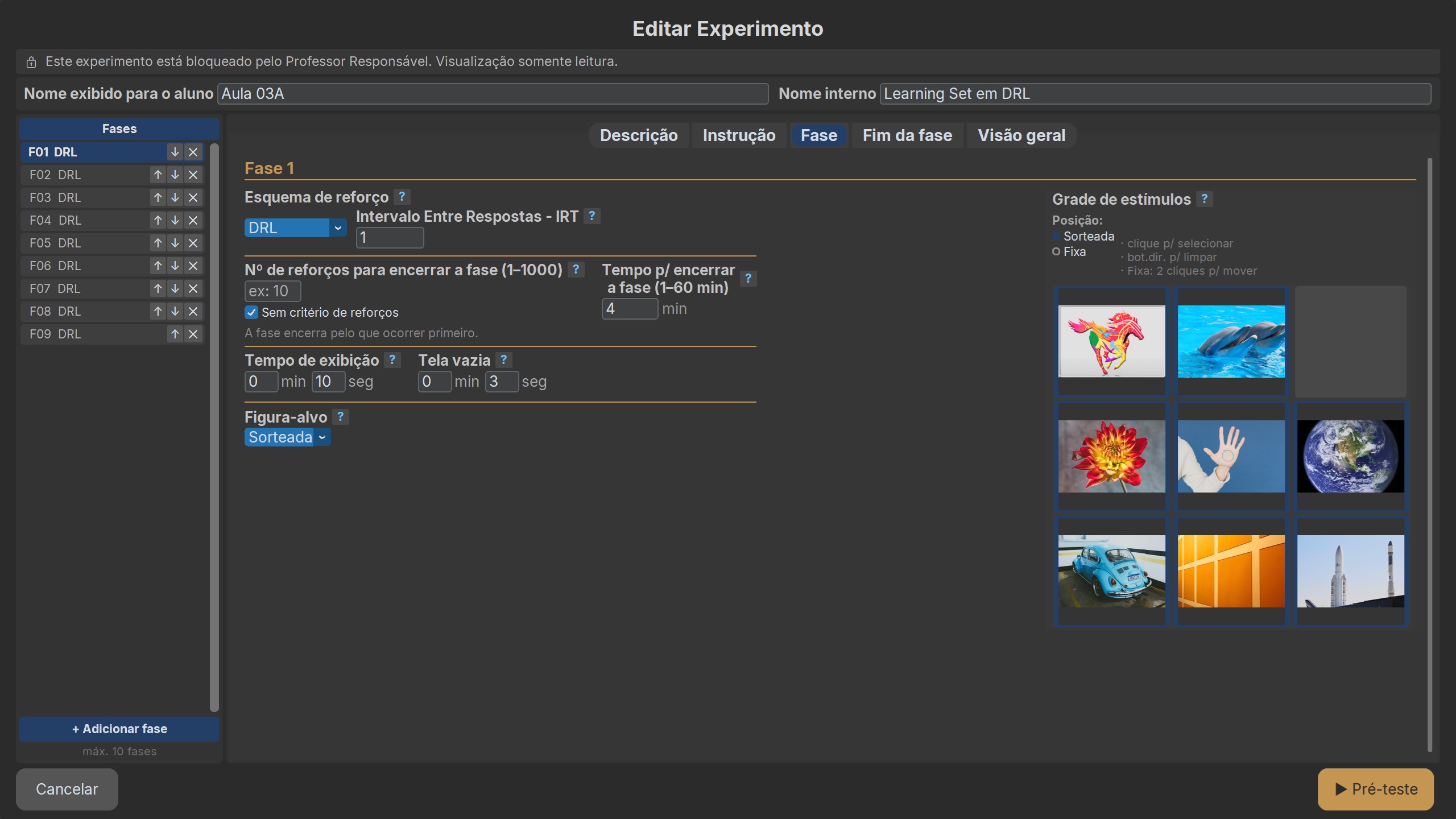
OperantLab recreates the classic experiments used in the undergraduate Psychology program for the Experimental Behavior Analysis course. The key difference is that, instead of studying the basic principles of behavior in a real or virtual rat, the student takes part as the experimental subject. By going through the very same procedures — such as reinforcement, extinction, conditioned reinforcement, discrimination and generalization — they build the graphs from data on their own behavior, analyze them and observe the principles of operant behavior happening within themselves.
Going beyond the classic laboratory, the platform also lets the teacher create custom experiments. This way, the student learns to manipulate variables in studies with human beings, investigating the dynamics of verbal and non-verbal behavior.
For decades, the study of operant conditioning relied on animals in the laboratory. Over time, laws such as the Health Research Extension Act (USA, 1985) and Brazil's Lei Arouca (Law No. 11,794/2008) established mandatory ethics committees — IACUC and CEUA — for any research involving animals. Approvals began taking months, operational costs rose, and access to animal behavior laboratories moved out of reach for most institutions.
In 1994, Sniffy the Virtual Rat emerged as an alternative: no animals, no bureaucracy. Sniffy evolved through its most recent version in 2011, offering 47 practical exercises. But the limitation remains — behavior is generated by algorithm, not by a living organism. The data are not real.
OperantLab™ solves this. Developed by an instructor with 25 years of teaching Experimental Behavior Analysis — 20 years with real rats, 4 years with the virtual rat — the software is born from the hands-on experience of someone who knows both realities. Using figures as visual stimuli, it collects responses from real human participants — no CEUA or IACUC required, no vivarium costs, with genuine operant behavior data. In a computer lab or online research setting, real results with full legal compliance.
A simulator mimics a real system. OperantLab™ does not mimic anything — it is the experimental environment, generating valid data for Behavior Analysis research.
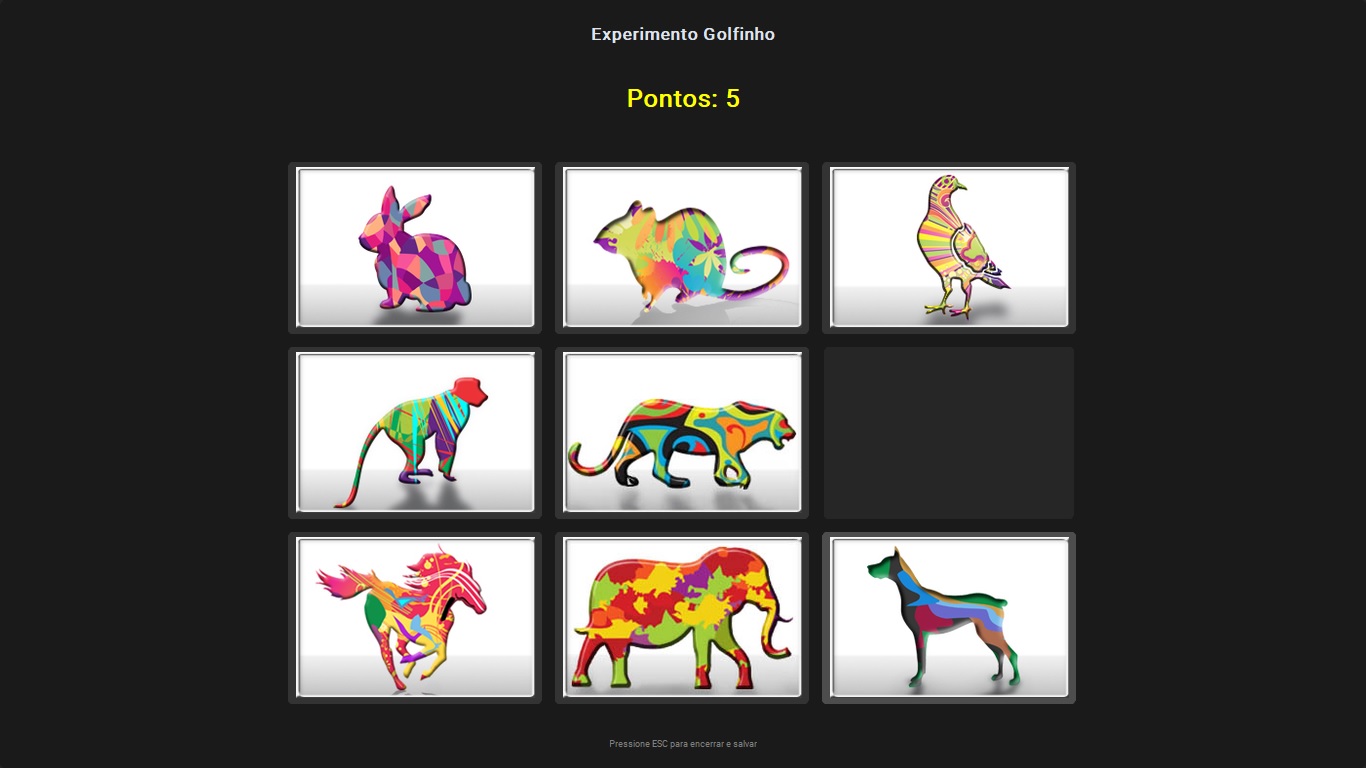
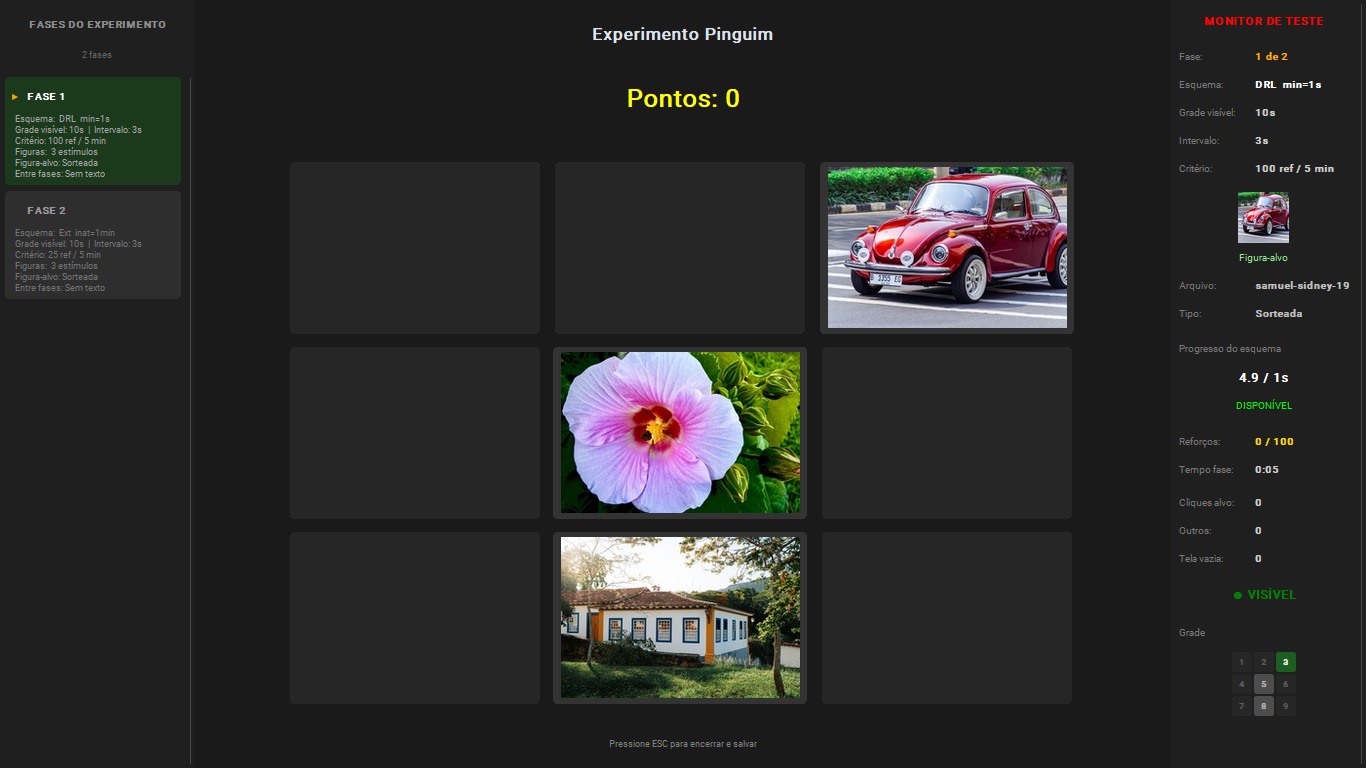
Participants interact with a 3×3 grid of figures. Each click is an operant response — and the software delivers or withholds reinforcement according to the schedule configured by the instructor.
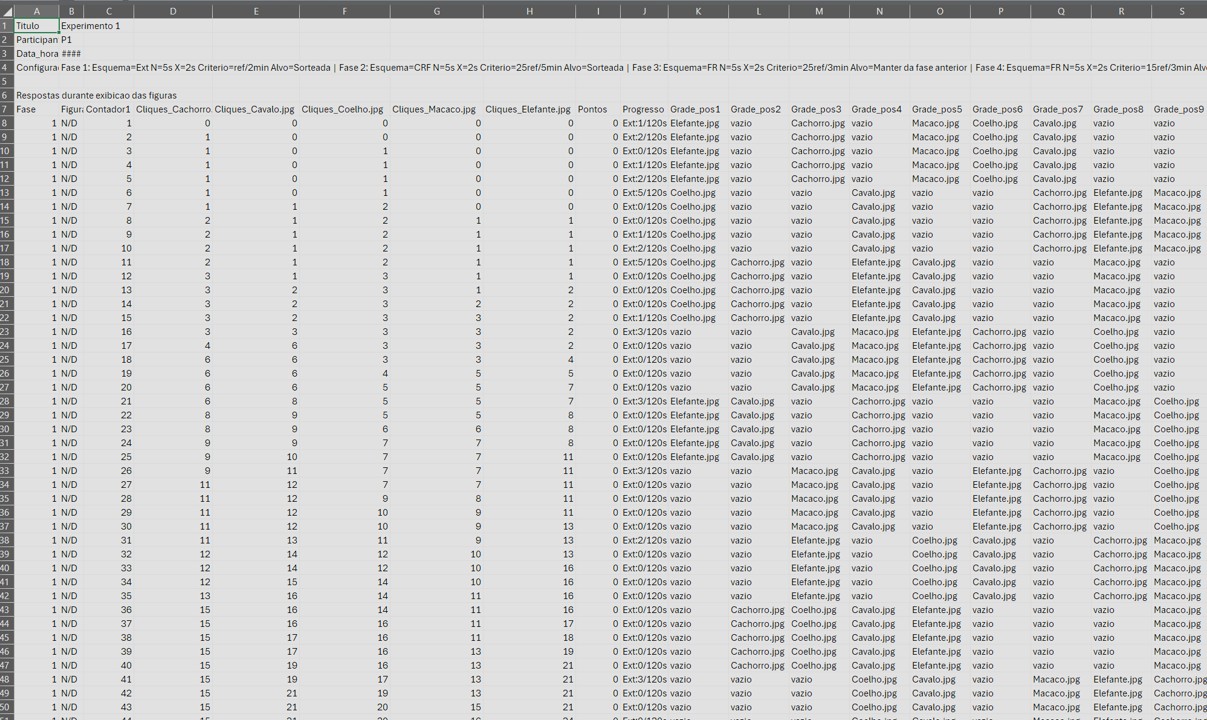
Each session generates a CSV file with experiment configuration, responses per second, clicks per figure, latencies, reinforcements and text responses between phases. Ready for Excel or statistical analysis.
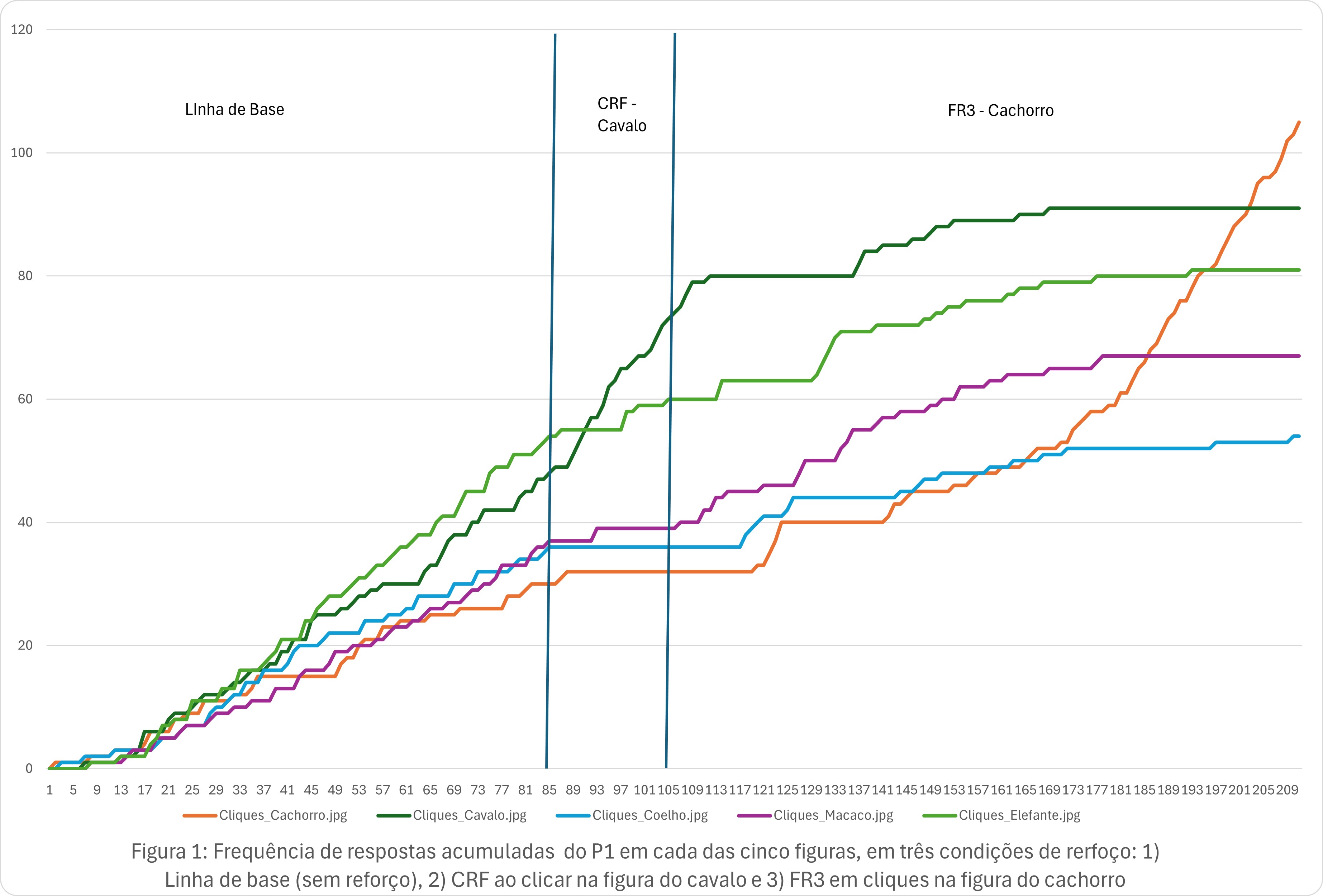
Acquisition, extinction, stimulus control, self-control, high rate in FR and low rate in DRL: classic Behavior Analysis concepts become visible to students in a 15-minute session.
unique configurations per experiment — combining 11 reinforcement schedules, independent numerical parameters, and custom visual stimuli. Every protocol you create is a genuinely new experiment.
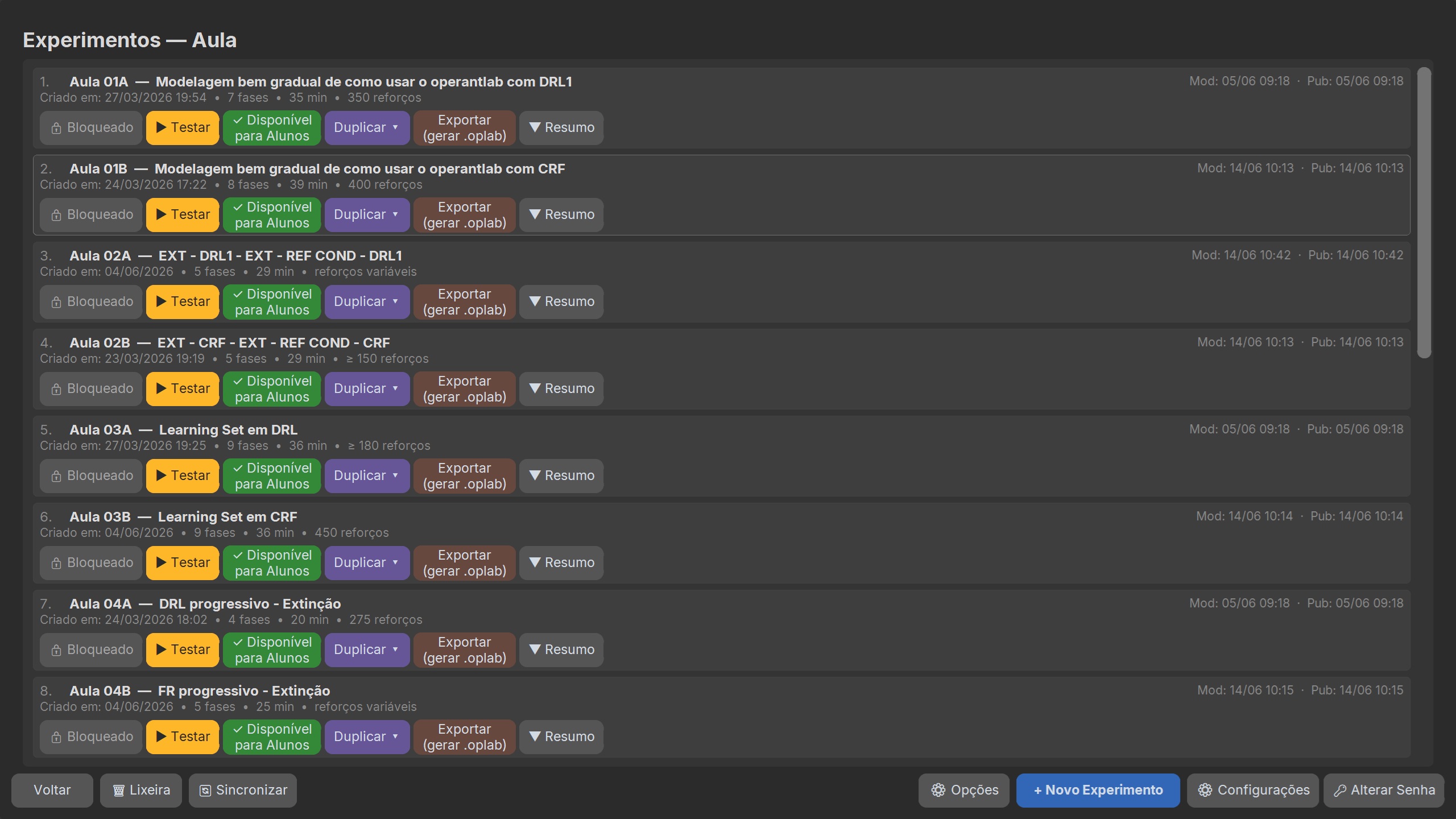
Instructors configure didactic experiments — FR, DRL, extinction, fading — and students run them in class, with real data collection for discussion.
Researchers publish protocols for their participants and synchronize data across lab machines. Files are protected on the server with AES-256-GCM encryption — the key stays solely with the institution, unreadable by OperantLab.
Compatible with institutional computer labs — Windows 10/11 and Linux, no permanent internet connection required during sessions.
CRF, FR, VR, FI, VI, FT, VT, DRL, DRH, Extinction and LAG — all with configurable parameters.
Pre-test panel shows clicks, reinforcements, progress, target figure thumbnail and grid state — all in real time.
Cumulative Response Frequency record. Each session generates a CSV file with headers, configuration and three data sections — ready for Excel, R or SPSS.
Share complete experiments between machines with .oplab files — configuration and figures embedded.
Interface in Portuguese, English and Spanish — no barrier for international students or collaborations.
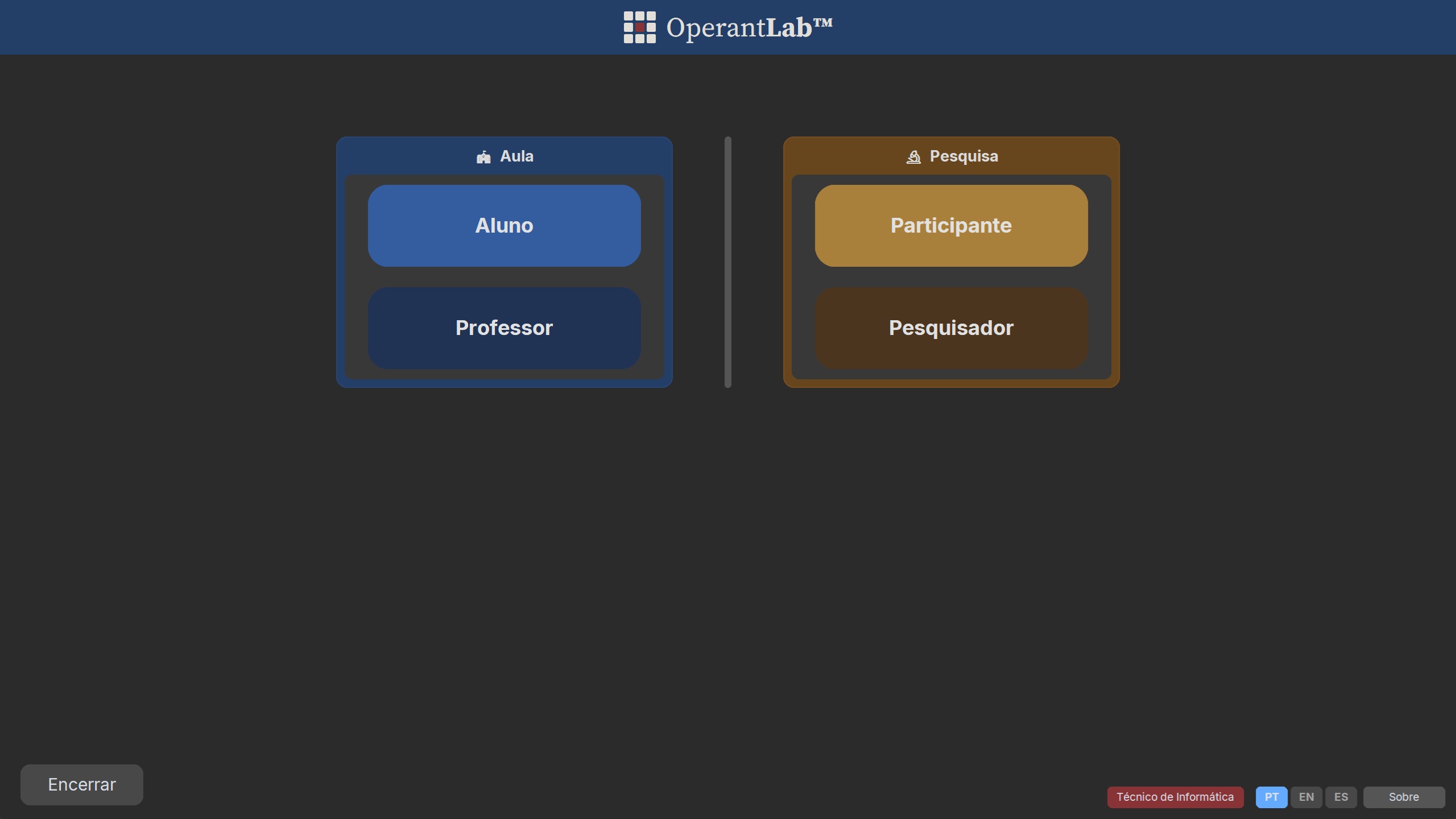
Teaching environment (Instructor + Student) and Research environment (Researcher + Participant) — independent, with no mutual interference.
Configure multiple stimulus figures with selective reinforcement to demonstrate discriminative learning and stimulus control development.
Present stimulus variations after discrimination training to observe and quantify response generalization across similar stimuli.
Implement gradual fading procedures of prompts and auxiliary stimuli to transfer stimulus control in a programmed and systematic way.
OperantLab™ cannot form a functional stimulus class, but it can be used to test whether a functional stimulus class has been established.
Implement instructions and rules as verbal discriminative stimuli to study how verbal behavior controls operant responses in varied contexts.
Students and participants can write about their own rules during the session and/or feelings between phases.
Offer your students a laboratory experience other programs don't have. Experimental Behavior Analysis, Learning and Radical Behaviorism courses gain a real hands-on component, not merely a demonstration.
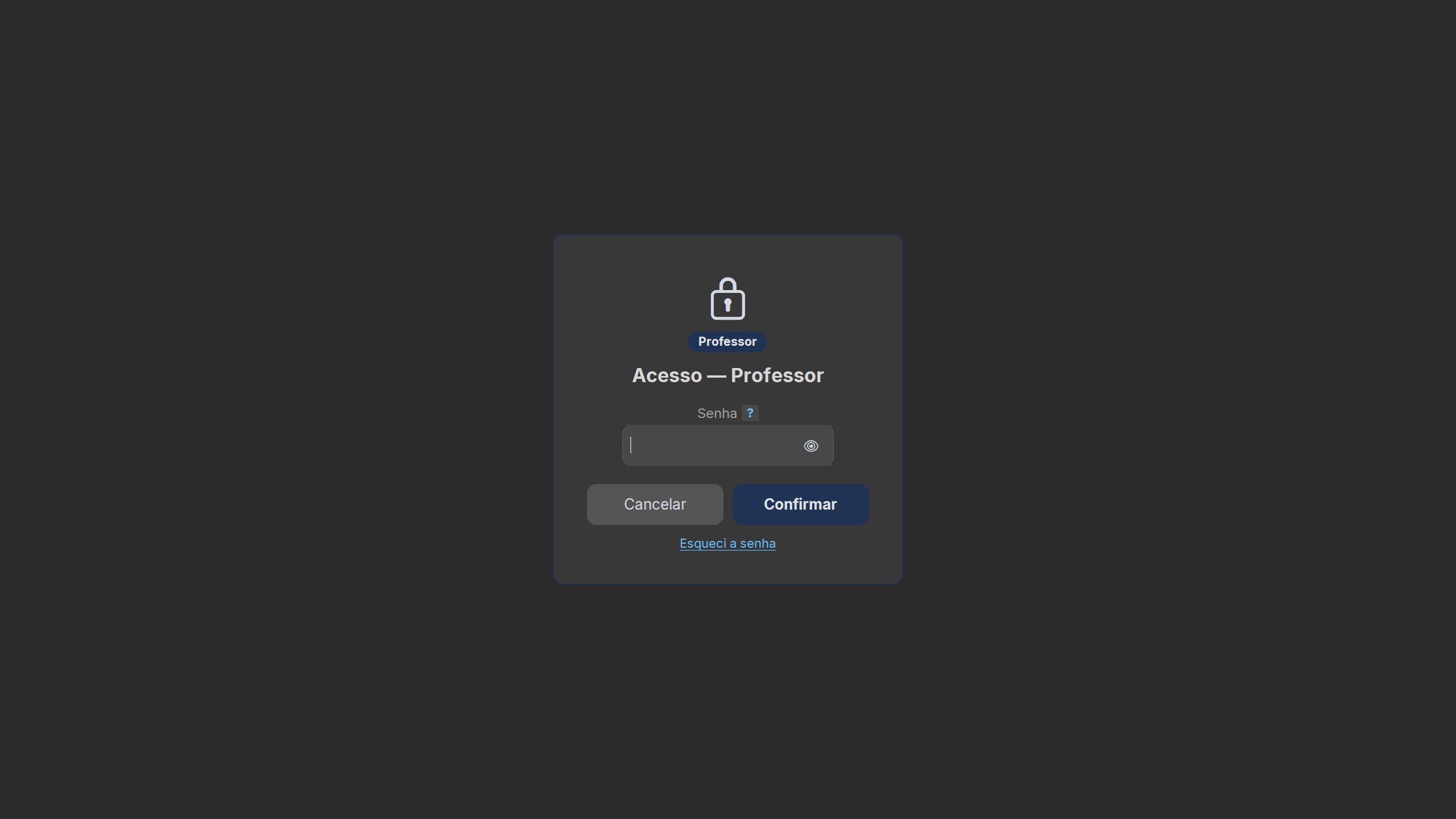
Configure an experiment in minutes. Run it with the entire class in the computer lab. Use the generated CSVs to discuss, in class, the acquisition curve, high rate in FR and low rate in DRL, or resistance to extinction — with your students' own data.
Environment independent from Teaching. Allows the researcher (or graduate student) to build their own protocols and run data collection with participants without interfering with didactic material. Supports multiple phases, precise time control and automatic data export.
OperantLab™ comes with pre-configured experiments — just open, run and discuss the data with your class.
Introduces the software gradually — starts with one stimulus and adds one per phase until reaching 7 stimuli, always under CRF.
Contrasts CRF acquisition with two extinction periods — the second with conditioned reinforcement (points) — followed by a return to CRF. Demonstrates the role of the conditioned reinforcer in maintaining behavior.
Series of 9 discrimination problems under CRF, each with a new correct stimulus. Errors decrease across trials within each problem, demonstrating the learning set effect.
The requirement rises progressively from CRF to FR2, FR3 and FR4, until extinction. Demonstrates resistance to extinction following a fixed-ratio schedule.
Discrimination training under FR3 followed by extinction with new stimuli. Demonstrates how stimulus control established with one set of stimuli generalizes to novel ones.
The SD is gradually faded across 6 phases of FR3. Demonstrates how stimulus control can be transferred with zero errors (errorless learning).
The LAG grows progressively from 1 to 4, requiring increasingly varied responses. Demonstrates the selection of variability by consequences.
Click to enlarge.
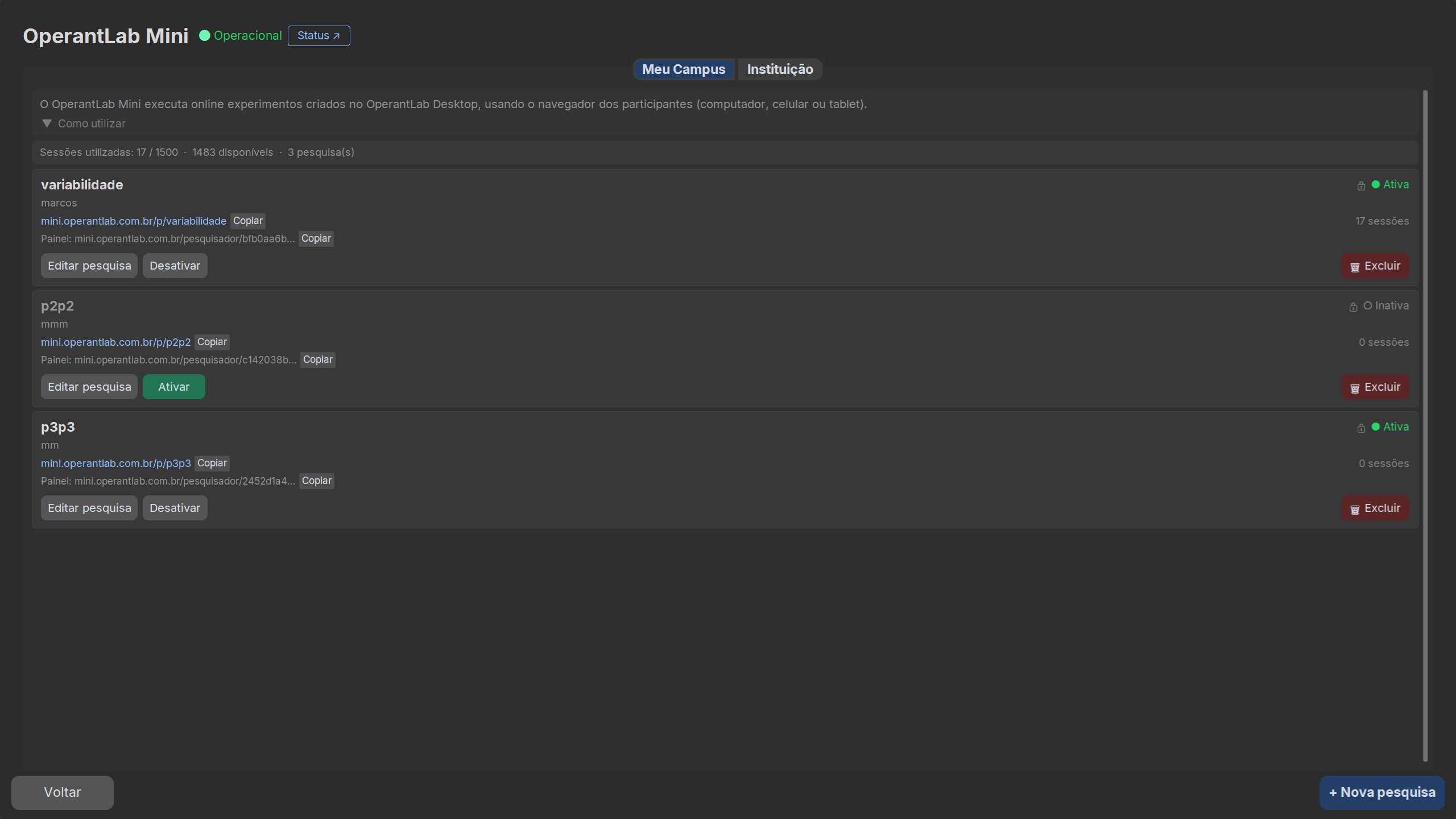
Earlier versions (v1.0 – v2.0.7): Publication scope (campus-only or institution-wide) with Responsible Teacher approval; installer digitally signed with an EV certificate (no Windows SmartScreen warning); Responsible Teacher with class-experiment locking and e-mail password recovery; OperantLab Mini (integrated online data collection, web researcher panel with 8 tabs, per-campus limits, “Available on Mini” button), redesigned experiment editor with 4 tabs and stimulus gallery, Fingerprint v2 (BIOS UUID + CPU ID), OTP email activation, LAG schedule, full CSV export, AES-256 encryption, cross-machine sync, and 30+ bug fixes. View all releases on GitHub ↗
Install, configure your experiments, run them with your class. No credit card, no remote installation — the software runs entirely on the lab machine.
Choose the version for your system (Windows or Linux) and download directly. Immediate access to all 11 schedules, no time limit or feature restrictions.
Full access to all 11 schedules, all roles, data export, didactic examples. No limitations. No credit card required.
At the end of the trial, the software will guide you through activation. The license is bound to the machine's hardware. Request as many licenses as your institution needs.
Requires a glibc 2.35+ Linux distribution (Ubuntu 22.04+, Debian 12+, Fedora 36+).
Windows alternative: Instalador_OperantLab_v2.1.4.exe
Linux alternative: OperantLab_linux_v2.1.4.tar.gz
All versions: github.com/operantlabsoftware/operantlab-releases
OperantLab Image Converter — free utility to convert images to the correct format (245×165 px) used in experiments. No installation needed — download and run.
All manuals in PDF, ready to read and print. Each profile has its own — or download the Complete Manual with all three together.
Coordinators and instructors: we respond within two business days with installer and guidance.
We are available to present the system in faculty meetings, give a live demonstration for your class, or answer technical questions about integration with your institution's computer lab.